
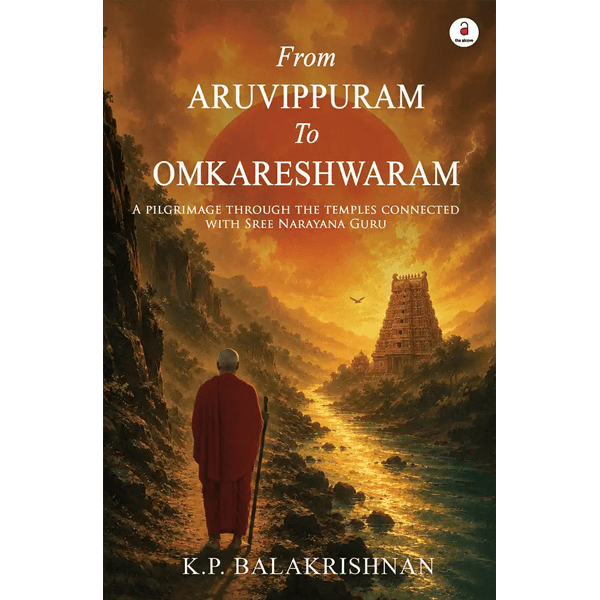

“In 1888, Sree Narayana Guru shattered centuries of rigid social hierarchy with a single, defiant act on the banks of the Neyyar River: the Aruvippuram installation. What began as a local challenge to religious monopoly soon evolved into a far-reaching blueprint for universal human dignity. Aruvippuram to Omkareswaram traces this profound philosophical journey—from practical social reform to the realization of absolute, cosmic non-duality.
This book is more than a pilgrimage through the temples associated with Sree Narayana Guru. It is a journey into the social, spiritual, and cultural revolution envisioned by one of India’s greatest sages.
For Gurudevan, a temple was never merely a place of worship. He believed that temples need not be built through extravagant expenditure or burdened by costly festivals and fireworks. Instead, they should serve as centres of learning, social awakening, and human welfare. He envisioned temples with spacious halls where people could gather, engage in meaningful discussions, and educate themselves; institutions where children could receive education and vocational training; and places where offerings from devotees would be channelled towards the upliftment of the economically disadvantaged.”


